

Employee badge inspiration
10 Creative Employee Name Badge Ideas That Stay Easy to Read
A good employee badge can show personality while helping people find the right person. These ten practical ideas balance brand style, useful details and everyday readability.
Updated November 12, 2026 · 5-minute read
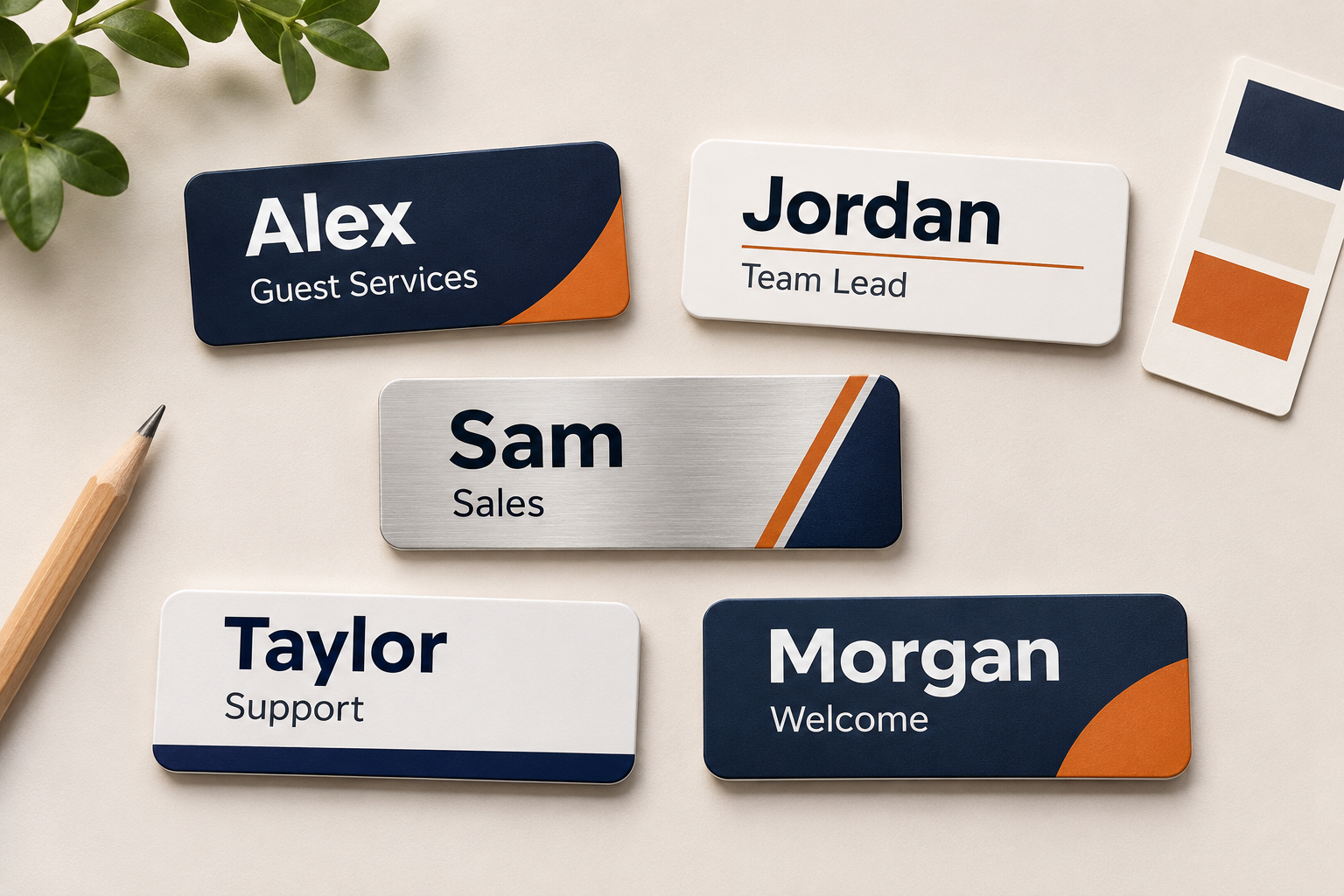
10 ideas worth trying
1. Put the preferred display name first
Ask employees how they want their names displayed and confirm spelling before ordering. Use a consistent policy that fits your workplace’s identification and privacy needs. Leave enough room for longer names instead of shrinking them until they become difficult to read.
2. Add a plain-language role
A short label such as “Guest Services” or “Team Lead” tells visitors who can help. Prefer familiar wording over internal acronyms. Keep the role smaller than the name, but large enough to read without leaning in.
3. Use a small brand-color accent
A narrow edge, corner detail or divider can carry your brand color while leaving a calm area for text. Check the design against the actual uniform. A beautiful color pairing on a screen may disappear against a patterned shirt.
4. Give the logo its own space
Keep the logo separate from the name rather than placing letters over it. If a detailed logo loses clarity at badge size, ask about an approved simplified version. Do not stretch the artwork to fill a space.
5. Pair a department label with color
A department color can help staff recognize a group, but include a written label too. A visitor should not need to memorize a color key to find “Service” or “Sales.” Keep the same layout across departments.
6. Include an optional language line
If an employee wants to offer help in another language, a short, accurate line such as “Hablo español” can be useful. Confirm the wording and employee preference. Do not infer language ability from someone’s name or background.
7. Add a voluntary conversation prompt
For a welcoming retail or hospitality setting, consider a brief prompt such as “Ask me about local trails.” Let the employee choose whether to participate, keep it relevant to the setting, and avoid personal details they would rather keep private.
8. Recognize a specific achievement
A small “5 Years” line or an approved mentor designation can acknowledge a real milestone. Keep the criteria clear and make sure the information stays current. See our guide to recognition badges for more planning ideas.
9. Keep the design, change the insert
For seasonal teams, a consistent holder with a replaceable name insert can simplify updates. Compare reusable name tags and check how the insert is prepared, fitted and replaced before choosing a format.
10. Choose a restrained finish
A simple finish and clean typography can create a polished look without extra decoration. Review a sample under your workplace lighting: reflections and small lettering can matter more than how a finish looks in a product photograph.
Turn the idea into a usable badge
Start with a short brief: who will wear it, who needs to read it, what information matters most, and what uniform it must work with. Browse plastic name tags to compare available styles, then confirm whether your preferred layout and artwork can be produced.
For broader legibility principles, the RNIB product design guide (PDF) discusses making important information prominent and choosing readable lettering. It is a useful design resource, not a certification of any particular badge.
- Review the proof at actual size, not only enlarged on a screen.
- Try the longest name and title in the group.
- Check spelling, logo proportions, text contrast and spacing.
- Test the badge with the intended clothing and attachment.
- Confirm current pricing, production timing and shipping for the final configuration.
For attachment considerations, read magnetic vs. pin-back name tags. If the badge will also serve an identification or access-control function, have the relevant team review that requirement separately.
Questions about creative employee badges
How much information belongs on a name badge?
Start with the name and a useful role or organization. Add another detail only if it helps the person reading it. If the name becomes small, remove secondary content or choose a larger suitable format.
Should everyone use the same layout?
A shared layout makes ordering and recognition simpler. Allow enough flexibility for long names and approved optional details, while keeping the same visual priority for the name.
Can an employee use a preferred name?
Use a clear workplace policy and confirm the employee’s preference. Some roles or identification systems may have additional requirements, so check those before finalizing the display name.
Are QR codes necessary?
No. Add one only for a clear purpose, such as a public information page, and test the printed code before ordering. Avoid putting private employee information behind a publicly readable code.
What is the best way to choose between two designs?
Print both at actual size and ask a few intended users to read them in the real setting. Compare name readability, useful information and comfort with the uniform—not just which design looks more decorative.