

THE NAME TAG GUIDE
Magnetic vs. Pin-Back Name Tags: Which Should You Choose?
A practical guide to clothing, comfort, cost, and choosing a fastener your team can use every day.
NameTagCountry guide · Updated November 11, 2026 · 5-minute read
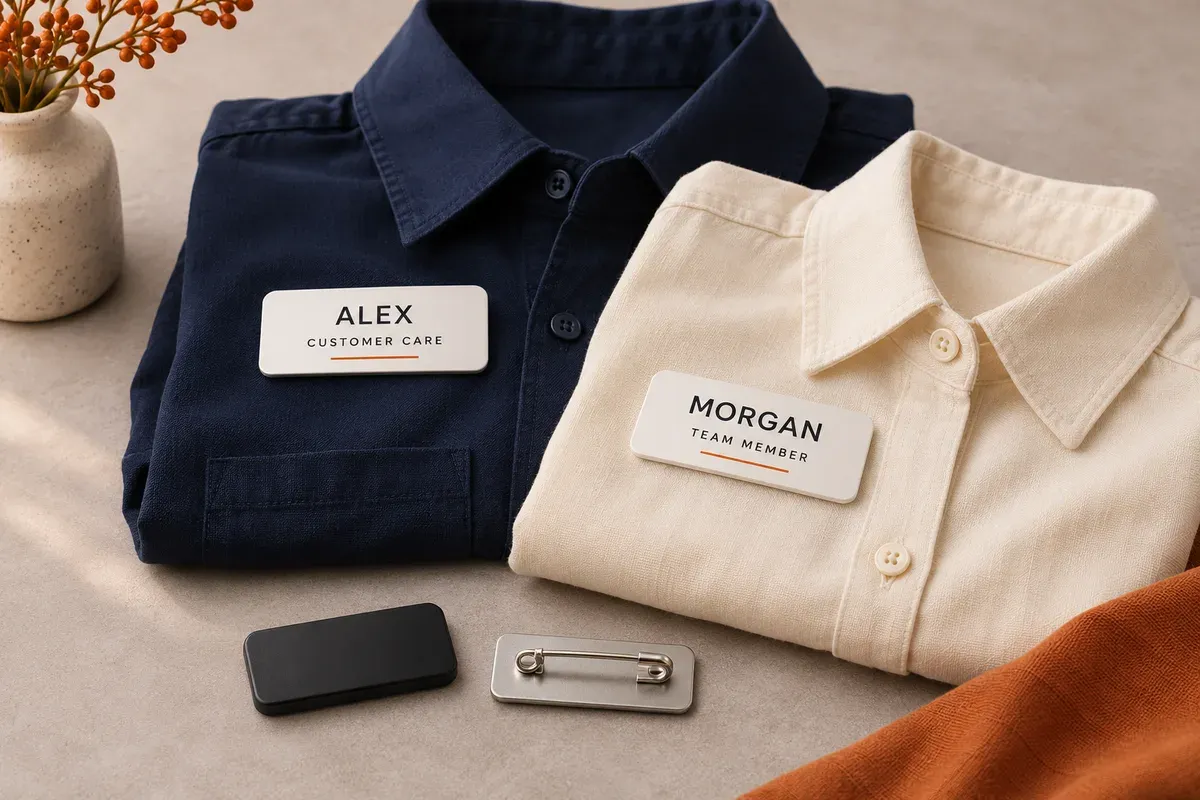
The quick answer
Choose a magnetic backing when avoiding pinholes is a priority and the fastener suits the wearer and clothing. Choose a pin backing when a nonmagnetic attachment is needed and the garment can tolerate a pin. Neither is best for every person, fabric, or workday.
For a team order, test a sample on the actual uniform and offer an alternative attachment where needed.
Magnetic and pin backings at a glance
| Factor | Magnetic | Pin-back |
|---|---|---|
| Clothing | No puncture; test on your fabric | Pierces fabric; may leave holes or snag |
| Everyday use | Two pieces align through clothing | Pin passes through fabric and closes |
| Fit and hold | Check fabric thickness and badge weight | Check fabric strength and closure |
| Cost | Compare the selected product and quantity | Often a lower-cost fastener; verify the total |
| Wearer needs | Check implanted-device guidance | A nonmagnetic option; still check workplace rules |
When a magnetic name tag makes sense
A magnetic fastener holds the badge through the garment: one part is attached to the badge and the other sits inside the clothing. NameTagCountry’s complete magnet fastener includes both the metal bar for the badge and the magnetic backing.
Because a magnet does not pierce the fabric, it can be a useful choice for dress shirts and garments where pinholes are unwelcome. That does not guarantee that every fabric will remain unmarked. Check for pulling, impressions, slipping, or discomfort on the clothing your team actually wears.
Test the combination of badge size, badge weight, fabric thickness, and normal movement. A backing that feels secure on a lightweight shirt may behave differently through a jacket or several layers. Keep the removable backing with its badge when it is not in use.
When a pin-back name tag makes sense
A pin fastener passes through the garment and closes behind it. It can be a practical choice for uniforms that tolerate pinning, especially when the wearer needs a nonmagnetic attachment. NameTagCountry’s standard pin fastener is one option to compare.
The tradeoff is contact with the fabric: the pin can leave a small hole or catch a thread. Delicate fabrics deserve particular care. Close the fastener fully, check it for damage, and remove the badge before laundering the garment.
Do not assume a pin automatically makes a badge more durable. The badge material, print or engraving, adhesive, closure, and handling all affect how well the complete name tag holds up.
Cost and reuse: compare the whole order
At the time of review, the standalone pin fastener is listed for less than the complete magnetic fastener. Their quantity tiers differ, so compare the actual quantity you need rather than just the lowest advertised price. Use the linked product pages for current pricing, and confirm which backing is included with your chosen name tag.
Both attachment types can be reused while they remain in good condition. Reuse alone does not establish that one option is environmentally preferable. Avoid treating a magnet, pin, or badge material as “eco-friendly” without evidence about the specific product and its lifecycle.
A simple checklist before ordering for a team
- Start with the wearer. Check workplace rules and offer another attachment for people who cannot use a magnet or find a particular closure difficult to handle.
- Try the real uniform. Test the badge while sitting, bending, and moving through a normal shift. Check for slipping and fabric stress.
- Check readability. Make the name easy to find, use clear contrast, and avoid crowding the badge with unnecessary text.
- Check the complete price. Review badge size, material, fastener, order quantity, and shipping before comparing totals.
- Confirm the deadline. Production time and shipping time are different. Check the current terms and confirm your required arrival date before placing a time-sensitive order.
Find the right backing for your badge
Explore the fasteners first, then choose a badge material and design that fit your team.
Compare name tag fasteners →Related reading: Lanyards, clips, or magnets: choosing an attachment.
Questions about magnetic and pin-back name tags
Do magnetic name tags damage clothing?
They avoid the puncture made by a pin, but no fastener is a guarantee against marks or fabric stress. Test the badge on the intended garment, particularly delicate or lightweight material.
Will a magnetic name tag stay on a thick jacket?
It depends on the fastener, the fabric layers, the badge weight, and movement. Test the actual combination before ordering for everyone; do not assume a magnet will hold equally well through every jacket.
Can someone with a pacemaker wear a magnetic name tag?
Do not assume it is suitable. Magnets can interfere with implanted heart devices. Follow the device manufacturer’s and clinician’s advice, and provide a nonmagnetic option when appropriate. The American Heart Association guidance is linked above.
Are pin-back name tags cheaper?
The standalone pin fastener reviewed here is listed below the complete magnet fastener, but the finished badge price depends on the product, quantity, and selected options. Compare current order totals rather than assuming the same price difference applies to every badge.
Can I change the backing on an existing name tag?
Sometimes, but check the badge surface, adhesive, and dimensions first. Removing an attached fastener may damage the badge. A replacement magnet backing is only the piece worn inside the garment; it is not the same as a complete magnet fastener.
Can both types be reused?
Yes, if the badge and fastener remain in good condition. Inspect the closure or backing regularly, keep loose magnetic pieces with their badges, and remove the name tag before washing the garment.